
ISSUE 05 | November 19, 2026
Evaluating Whistler: Understanding an Initial Assessment and PEA
What an initial economic assessment tells investors about a mineral project
A mineral resource estimate provides an understanding of the quantity and grade of mineralization identified within a project. But how is the potential economic viability of a mineral resource evaluated?
Analyses, such as those included in an Initial Assessment or a PEA, bring together geological information, mining concepts, processing methods, infrastructure requirements and financial assumptions to provide a preliminary picture of how a mineral project could potentially be developed and operated.
In March 2026, we announced the results of an Initial Assessment with economic analysis prepared in accordance with U.S. SEC Regulation S-K 1300 (S-K 1300), alongside a Preliminary Economic Assessment (PEA) prepared in accordance with Canadian National Instrument 43-101 (NI 43-101).
Together, these studies provide a preliminary evaluation of the potential economics of the Whistler deposit under the respective U.S. and Canadian reporting frameworks.
What Does an Initial Assessment or PEA Tell Us?
An Initial Assessment that includes an economic analysis, or a PEA, evaluates how a mineral deposit could potentially be mined and processed, and what the associated costs and projected financial returns might look like. It is important to note that additional work and studies are required to advance to more definitive economic studies such as a pre-feasibility or feasibility study to declare mineral reserves.
A study typically considers:
- Mining and processing: How mineralized material could be extracted most economically and then processed to produce a saleable product such as ore concentrate or unrefined metal (e.g. gold doré).
- Infrastructure: The facilities and supporting infrastructure required for a potential mining and processing operation e.g. civil engineering works, crushing and flotation circuits, power generation and distribution, workshop and housing for the workers.
- Capital and operating costs: The estimated investment to establish and operate the project.
- Production estimates: The anticipated production profile and estimated mine life.
- Project economics: Financial measures used to model the potential economics of the proposed operation.
Together, these elements provide an initial conceptual picture of a project's potential development.
Understanding the Numbers
Three financial measures frequently highlighted in economic assessments are Net Present Value (NPV), Internal Rate of Return (IRR) and payback period.
- NPV: Estimates the present value of projected future cash flows, less the initial investment, using a specified discount rate.
- IRR: The projected annualized rate of return of an investment over its life. Mathematically, it is the discount rate at which the project's NPV equals zero.
- Payback period: The estimated amount of time it takes to recover the initial capital investment through projected cash flows.
These measures offer different perspectives on a project's modeled economics and are influenced by assumptions such as commodity prices, production rates, capital costs and operating expenses.
A Closer Look at our Whistler Gold-Copper Project
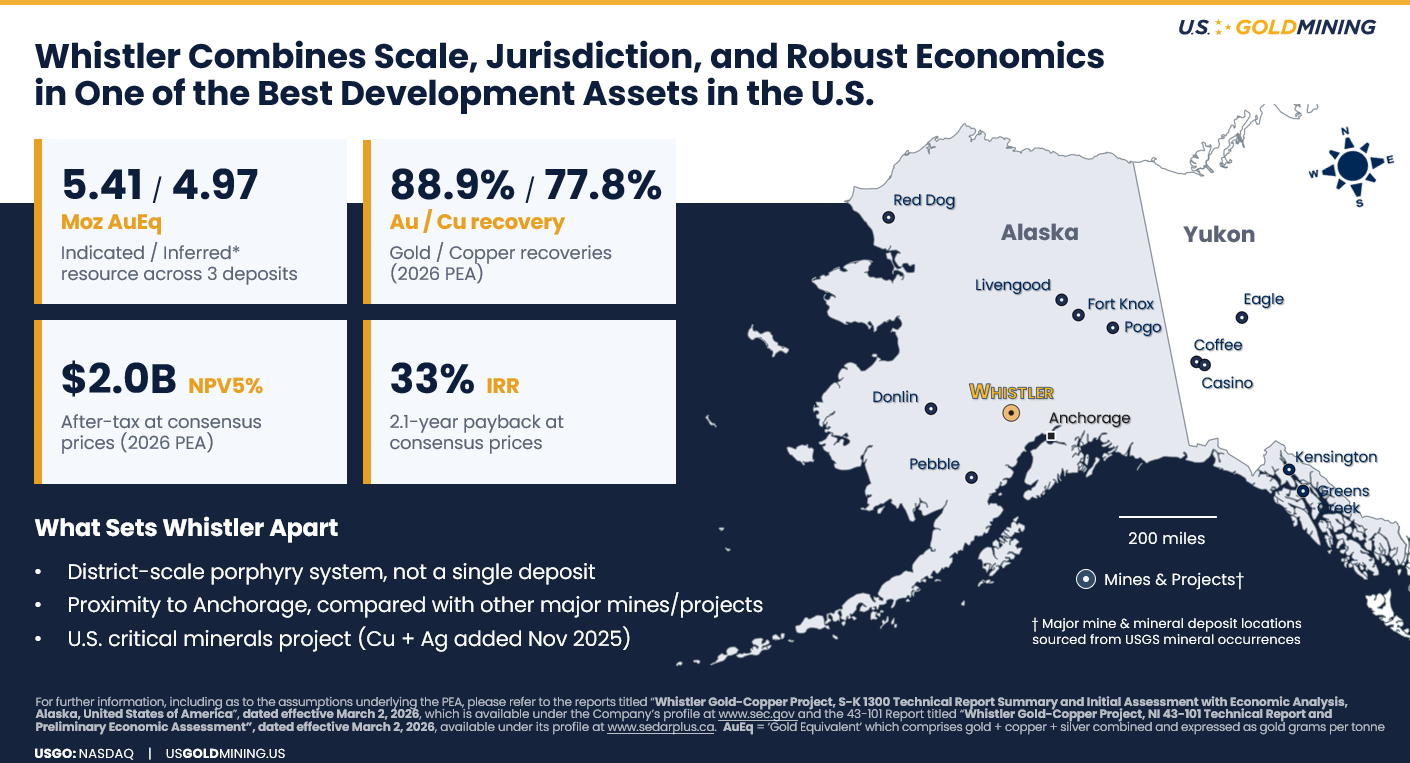
Our 100%-owned Whistler Gold-Copper Project is located in Alaska and comprises approximately 53,700 acres of State mining claims. The project includes three drill delineated deposits – Whistler, Raintree West and Island Mountain – within a broader mineral district that we believe is prospective for additional future exploration.
The current drill delineated mineral resource estimate includes:
| Mineral Resource | Gold Equivalent (AuEq) |
| Indicated | 5.41 Moz |
| Inferred | 4.97 Moz |
Mineral resource estimate note: AuEq = ‘Gold Equivalent’ comprises gold, copper and silver combined and expressed as gold grams per tonne (g/t). The AuEq formula is AuEq (g/t) = Au (g/t) + 0.9361 × Cu (%) + 0.0055 × Ag (g/t), based on metal prices of US$2,750/oz Au, US$4.35/lb Cu and US$30/oz Ag. The indicated resource contains 3.97 million ounces (Moz) Au, 991.7 million pounds (Mlb) Cu and 17.92 Moz Ag, while the inferred resource contains 4.36 Moz Au, 390.4 Mlb Cu and 14.26 Moz Ag. Metallurgical recoveries assumed in the resource estimate are 87.8% Au, 75.4% Cu and 49.1% Ag. Mineral resources that are not mineral reserves do not have demonstrated economic viability. Inferred mineral resources have a high degree of uncertainty as to their existence and as to whether they can be economically or legally mined. Refer to the Company’s S-K 1300 technical report summary titled “Whistler Gold-Copper Project, S-K 1300 Technical Report Summary and Initial Assessment with Economic Analysis, Alaska, United States of America”, dated effective March 2, 2026, available under the Company’s profile at www.sec.gov and the Company’s NI 43-101 technical report titled “Whistler Gold-Copper Project, NI 43-101 Technical Report and Preliminary Economic Assessment”, dated effective March 2, 2026, available under the Company’s profile at www.sedarplus.ca.
These estimated mineral resources provide the foundation for the ongoing evaluation of the project. However, an important distinction is that the March 2026 preliminary economic analysis considers only the Whistler deposit and is based entirely on indicated mineral resources, with no inferred mineral resources included in the mine plan. The additional resources at Raintree West and Island Mountain were not incorporated into the economic analysis.
What Did the PEA Evaluate?
The March 2026 study evaluated a conceptual open-pit mining operation and processing facility with a proposed capacity of 40,000 tonnes per day.
Selected base-case results (using consensus metal prices) from the economic assessment included:
| Economic measure | Study estimate |
| After-tax NPV (5%) | US$2.04 billion |
| After-tax IRR | 33% |
| Initial payback period | 2.1 years |
| Initial capital cost | US$1.28 billion |
| Estimated mine life | 14.6 years |
| First three-year average annual production | 345,000 oz AuEq |
PEA notes: Results shown are based on consensus metal price inputs (base case): US$3,200/oz Au, US$4.50/lb Cu, US$37.50/oz Ag. The study also presents a sensitivity case using spot metal price inputs: US$5,000/oz Au, US$5.85/lb Cu, US$70/oz Ag. The economic analysis is preliminary in nature and there is no certainty that it will be realized. Refer to the Company’s press release dated March 2, 2026, the S-K 1300 technical report summary titled “Whistler Gold-Copper Project, S-K 1300 Technical Report Summary and Initial Assessment with Economic Analysis, Alaska, United States of America”, dated effective March 2, 2026, available under the Company’s profile at www.sec.gov and the NI 43-101 technical report titled “Whistler Gold-Copper Project, NI 43-101 Technical Report and Preliminary Economic Assessment”, dated effective March 2, 2026, available under the Company’s profile at www.sedarplus.ca.
The base-case analysis used assumed prices of US$3,200 per ounce of gold, US$4.50 per pound of copper, and US$37.50 per ounce of silver.
These results provide an indication of how the Whistler deposit could potentially be developed under the study's mining, processing, capital cost and commodity price assumptions.
It is important to recognize that these figures represent preliminary estimates based on the assumptions and technical information available at the time of the study. They are not actual operating results or a guarantee of future project performance.
Explore the Whistler Gold-Copper Project →
What Comes Next?
An Initial Assessment or PEA is an early-stage economic evaluation, not a construction decision or confirmation of economic viability.
Further work is generally required to refine a project's technical and economic assumptions. This may include additional drilling, metallurgical testing, engineering, environmental studies and permitting assessments.
More advanced studies, such as a Pre-Feasibility Study or Feasibility Study, involve increasingly detailed technical and economic evaluations and are required before mineral reserves can be declared or economic viability demonstrated.
Looking Ahead
The 2026 Whistler Initial Assessment and PEA provide an initial economic framework for evaluating the project's potential. For investors, understanding both the results and the limitations of an early-stage assessment is important when considering the longer-term evaluation of a mineral project.
We completed our 2026 exploration program at Whistler, comprising 7,493 meters of drilling across 17 diamond drill holes and 10 target areas within the Whistler deposit area. Initial assay results are anticipated in the coming weeks, subject to laboratory turnaround times.
These results will provide additional geological information to support our ongoing evaluation of the Whistler Gold-Copper Project.
FROM THE ARCHIVE
Explore previous issues of The Orbit on the U.S. GoldMining website.
DO YOU HAVE MORE QUESTIONS?
Please reach out directly to our Investor Relations team via [email protected]
MORE FROM U.S. GOLDMINING
View our Corporate Presentation →
Whistler Gold-Copper Project →
Whistler PEA Technical Report →
TECHNICAL INFORMATION
The Initial Assessment, including the economic analysis therein, and PEA are preliminary in nature and there is no certainty that their results will be realized. Mineral resources that are not mineral reserves do not have demonstrated economic viability. An Initial Assessment or PEA is not a pre-feasibility or feasibility study and cannot be used as the basis for the determination of mineral reserves.
For further information, including regarding the mineral resource estimates and PEA referenced herein, please refer to the S-K 1300 technical report summary titled “Whistler Gold-Copper Project, S-K 1300 Technical Report Summary and Initial Assessment with Economic Analysis, Alaska, United States of America”, dated effective March 2, 2026, which is available under the Company’s profile at www.sec.gov and the Canadian National Instrument 43-101 technical report titled “Whistler Gold-Copper Project, NI 43-101 Technical Report and Preliminary Economic Assessment”, dated effective March 2, 2026, available under the Company’s profile at www.sedarplus.ca.
Tim Smith, P.Geo., Chief Executive Officer of the Company, has supervised the preparation of this newsletter and has reviewed and approved the scientific and technical information contained herein. Mr. Smith is a qualified person as defined under NI 43-101 and S-K 1300 and is not independent of the Company.
FORWARD-LOOKING STATEMENTS
Certain of the information contained in this newsletter constitutes "forward-looking information" and "forward-looking statements" within the meaning of applicable United States federal securities laws and Canadian securities laws ("forward-looking statements"), which involve known and unknown risks, uncertainties and other factors that may cause the Company's actual results, performance and achievements to be materially different from the results, performance or achievements expressed or implied therein. Forward-looking statements, which are all statements other than statements of historical fact, include, but are not limited to, resource estimates, the results of the Initial Assessment and the PEA, the potential to identify resource extensions or new mineralization, the timing of receipt and results of the 2026 exploration program, the potential development, permitting and timing of the West Susitna Access Project, the application and effect of federal permitting procedures and executive orders, the effect of government policy on domestic mineral development, and the Company's plans and expectations regarding the Whistler Project and future opportunities and proposed work and studies thereon. Words such as “expects”, “anticipates”, “plans”, “estimates”, “potential”, “intended”, “may”, “could” and “intends” or similar expressions are intended to identify forward-looking statements. Forward-looking statements are based on U.S. GoldMining’s current expectations, beliefs, assumptions, estimates and forecasts about the business and the markets in which it operates, including assumptions regarding commodity prices, the availability of financing, personnel and equipment, the development of infrastructure by third parties, and the receipt of required permits. Risks and other factors that could cause actual results to differ materially include, among others, fluctuating commodity prices, risks inherent with preliminary economic assessments and mineral resource estimation generally, economic risks, changing economic factors, variations in the underlying assumptions associated with the estimation or realization of mineral resources, the availability of capital to fund programs and future development work, the risk that the West Susitna Access Project or other regional infrastructure is delayed, modified or not completed, the fact that such infrastructure is outside the Company’s control, changes in government policy, including executive orders, litigation or other challenges to permitting decisions, accidents, labor disputes and other risks of the mining industry (including those associated with the environment), delays in obtaining governmental approvals or permits, title disputes, other risks inherent in the exploration and development of mineral properties, and the other risk factors set forth in the Company’s Annual Report on Form 10-K and other filings with the U.S. Securities and Exchange Commission at www.sec.gov and the Canadian Securities Administrators at www.sedarplus.ca. Although the Company has attempted to identify important factors that could cause actual results, performance or achievements to differ materially from those described in forward-looking statements, there may be other factors that cause results not to be as anticipated, estimated or intended. Accordingly, readers should not place undue reliance on forward-looking statements. There can be no assurance that forward-looking statements, or the material factors or assumptions used to develop them, will prove to be accurate. The Company does not undertake any duty to update any forward-looking statements, except as required under applicable securities laws.